The story of the child remembered in history as Little Albert remains one of the most unsettling episodes in the history of modern psychology. For decades, the infant who became the center of a widely cited behavioral experiment had no known identity. The world recognized him only through blurred black-and-white film clips and a few brief references in academic journals. While the study became famous for influencing psychological theory, it also left behind a troubling legacy that continues to spark debate about ethics, responsibility, and the treatment of vulnerable research subjects. Today, the short life of the child behind the name Little Albert serves as a powerful reminder that the pursuit of knowledge must never overshadow compassion and respect for human dignity.
The origins of this story stretch back several decades before the experiment itself, beginning with the groundbreaking work of Russian scientist Ivan Pavlov. In the late nineteenth century, Pavlov discovered that animals could learn behaviors through association. During his well-known laboratory experiments, dogs began to salivate whenever they heard a bell that had been repeatedly paired with the presentation of food. Pavlov called this phenomenon a conditioned reflex. His work laid the foundation for a new psychological perspective known as behaviorism, which suggested that behavior is largely shaped by environmental influences through patterns of reward, punishment, and learned associations.
Inspired by Pavlov’s discoveries, American psychologist John B. Watson sought to demonstrate similar conditioning in humans. In 1920, Watson and his research assistant Rosalie Rayner conducted an experiment at Johns Hopkins Hospital that would later become one of the most widely discussed studies in psychological history. Their subject was a nine-month-old infant described as healthy, calm, and unusually even-tempered. Because the baby rarely cried and seemed relaxed in unfamiliar situations, Watson believed the child would tolerate the experiment without significant distress. The boy would later be known around the world as Little Albert.
At the beginning, the study appeared harmless. The infant was presented with several soft animals and objects, including a white laboratory rat, a rabbit, and a friendly dog. Each time the child reached out with curiosity, the researchers carefully observed his reactions. Albert responded with interest and delight, touching the animals and exploring them without hesitation. According to Watson’s observations, the baby showed no signs of fear or discomfort. He rarely cried and seemed fascinated by the unfamiliar textures and movements around him.
The tone of the experiment shifted when Watson introduced a startling element. Whenever Albert reached toward the white rat, one of the researchers struck a steel bar behind the child with a hammer. The sudden noise was loud and unexpected, causing the infant to flinch and cry. After repeating this process several times, the baby began to associate the rat with the frightening sound. Soon he recoiled from the animal even when the noise was absent.
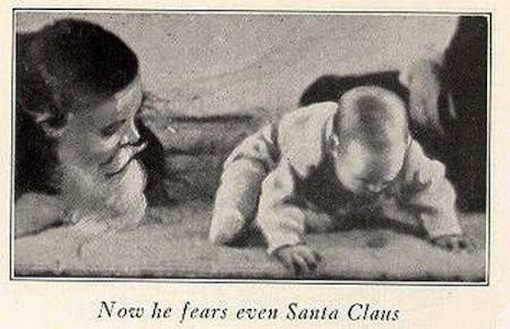
Over time, the fear extended beyond the white rat. The once curious child began to cry when he saw other furry objects. A rabbit, a dog, a fur coat, and even the fluffy white beard of a Santa Claus mask caused visible distress. Watson believed he had demonstrated a powerful example of conditioned emotional response in a human infant. Similar to Pavlov’s dogs learning to associate a bell with food, Albert had learned to associate harmless objects with fear.
Today, however, the experiment raises serious ethical concerns. The infant was far too young to give consent, and his mother, who worked at the hospital as a wet nurse, was reportedly never fully informed about the stressful elements of the procedure. When she eventually realized what had been happening, she removed her son from the study. Watson and Rayner suggested that they might later attempt to reverse the fear responses they had created, but historical records provide no evidence that such follow-up ever occurred.
For many years after the study, the identity of Little Albert remained unknown. Watson deliberately avoided publishing the child’s real name, leaving historians and psychologists to wonder who the boy truly was. The mystery lasted nearly ninety years. In 2009, a team of researchers carefully examined archival photographs, hospital records, and surviving film footage from the original study. Their investigation suggested that the infant was most likely Douglas Merritte, the son of a nurse employed at Johns Hopkins Hospital.
The discovery revealed an even more heartbreaking aspect of the story. Douglas Merritte died at only six years old from hydrocephalus, a medical condition in which fluid accumulates within the brain. Some evidence suggests that the child may already have been experiencing neurological difficulties long before the experiment took place. Historical records indicate he may have suffered from meningitis earlier in life and possibly showed signs of developmental challenges.
Psychologist Alan Fridlund later studied the surviving footage of the experiment and noticed several concerning details. He observed that the baby’s head appeared unusually large and that the child displayed limited social responsiveness compared with typical infants. Throughout several minutes of film, Albert never offered a clear social smile. Even when animals moved nearby or sudden noises occurred, he rarely looked toward the adults around him for reassurance.
Despite its scientific limitations and deeply troubling ethical questions, the Little Albert experiment left a lasting imprint on psychology. Watson used the study to support his theory that many complex human emotions develop from three fundamental responses: fear, rage, and love. Over time, however, many scholars criticized the research for relying on weak evidence and for overlooking the well-being of the child involved. Today, discussions about research ethics frequently cite this case as an example of why strict standards are necessary when conducting studies involving human participants.
The name Little Albert is now remembered not merely as a figure in psychological textbooks but as a real child whose life was brief and fragile. Douglas Merritte was more than a subject in an experiment. He was a son, a young boy who deserved care, safety, and understanding. His story continues to remind researchers and readers alike that scientific discovery must always respect the dignity of every individual. Knowledge can transform our understanding of the world, but compassion must guide every step we take in the pursuit of progress.