At first glance, they look like ordinary shoes, the kind you might pass without a second thought on a city sidewalk. There are no flashing lights, no bulky attachments, nothing that screams advanced technology. And yet, hidden within these shoes is a quiet system that speaks a language most people never hear, a subtle conversation between movement, space, and awareness that can change how someone experiences the world.
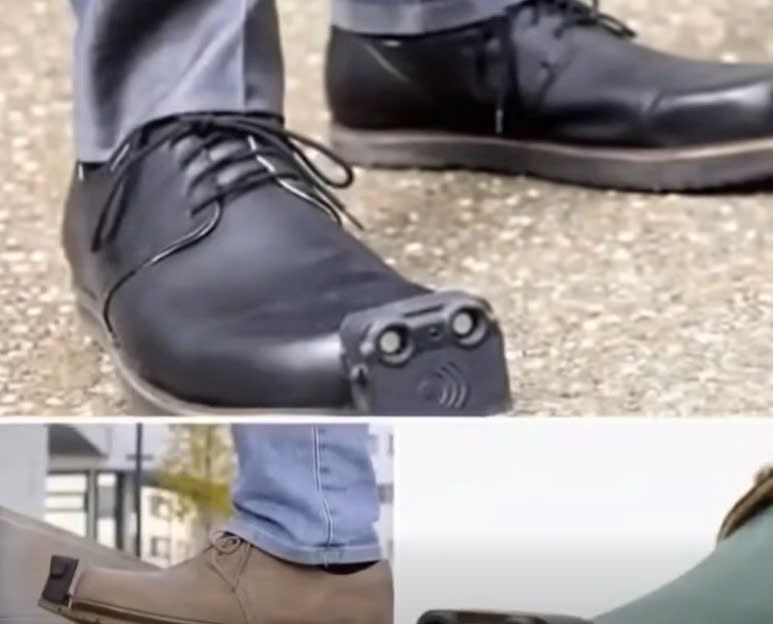
When the wearer walks near a wall, a staircase, or a moving vehicle, the shoes respond instantly. Gentle vibrations or soft audio alerts guide each step in real time, offering feedback without overwhelming the senses. Many users describe the experience as having a “parking sensor for people,” a constant but unobtrusive awareness that follows them wherever they go. The system can be purchased as a complete pair of shoes, or as a compact, waterproof sensor that easily attaches to footwear the user already owns.
The idea behind this innovation did not come from a distant research lab or a purely technical experiment. It was co-created by Markus Raffer, who is visually impaired and deeply familiar with the challenges of navigating everyday environments. His personal experiences shaped every detail of the design, ensuring the technology addressed real needs rather than imagined ones. By blending advanced engineering with empathy, the result is a product that gives thousands of people greater confidence, independence, and peace of mind.
The company behind the shoes continues to refine and expand the technology. Using artificial intelligence and camera-based recognition, the system creates what developers describe as a “foot-level street view.” Instead of relying on visual cues, the shoes map the surrounding environment in real time and translate that information into clear, intuitive signals. Obstacles, changes in elevation, and nearby movement are detected instantly, allowing the wearer to respond naturally without stopping or second-guessing each step.
This real-time feedback plays a crucial role in preventing accidents. Whether navigating crowded sidewalks, approaching staircases, or walking near parked or moving cars, users receive alerts exactly when they need them. The signals are designed to be discreet and easy to interpret, allowing wearers to focus on walking confidently rather than constantly scanning for potential hazards. Over time, many users report that the feedback becomes almost instinctive, blending seamlessly into their natural movement.
Beyond the practical safety benefits, the shoes offer something less tangible but equally powerful: a sense of empowerment. For many visually impaired individuals, moving through public spaces can be exhausting, both physically and mentally. The constant need for vigilance often leads to anxiety and hesitation. By reducing uncertainty and providing reliable guidance, these shoes help restore a feeling of freedom that many users thought they had lost.
People who use the technology frequently describe a renewed confidence when going outdoors alone. Simple activities like walking to a nearby store, navigating unfamiliar streets, or commuting through busy areas become less intimidating. The reduction in stress not only improves mobility but also has a positive effect on overall well-being. When movement feels safer, independence grows naturally.
The shoes, known as InnoMake, represent more than a technological achievement. They stand as a symbol of inclusion, showing how thoughtful design can bridge gaps that society often overlooks. Rather than treating visual impairment as a limitation to be managed, the product reframes it as a challenge that can be addressed through innovation and understanding. By focusing on the user’s lived experience, the designers created a tool that respects dignity while enhancing daily life.
Each step taken with these shoes becomes more intentional and controlled. The system transforms walking from an unpredictable task into a guided experience, one where users feel supported without feeling restricted. Instead of reacting to surprises, wearers gain the ability to anticipate their surroundings, engaging with the world on their own terms.
What makes this technology especially meaningful is its balance between simplicity and sophistication. The interface does not require complex training or constant adjustments. The alerts are intuitive, the design is practical, and the system adapts to different environments with ease. This accessibility ensures that the technology remains usable for people of varying ages, lifestyles, and levels of mobility.
In a broader sense, these smart shoes highlight the direction modern innovation is taking. Technology is no longer just about speed, power, or spectacle. Increasingly, it is about restoring independence, reducing barriers, and improving quality of life in quiet but profound ways. Products like this demonstrate that the most impactful innovations often work in the background, supporting human capability rather than replacing it.
By combining empathy, advanced technology, and thoughtful design, smart shoes like these offer far more than convenience. They provide reassurance, confidence, and the freedom to move through the world with greater ease. In doing so, they remind us that innovation can carry a message far deeper than what meets the eye, a message of dignity, independence, and hope for those who need it most.