My name is Ellie, I’m 27, and this fall I married Evan, the man who has been my steady place in the world for six years. He’s gentle, thoughtful, and the kind of person who brings me coffee before I’m even fully awake. We’ve never needed anything extravagant to feel happy together. Slow mornings, walks with our dog, and dancing around the kitchen to bad music have always been enough for us.
So when it came to planning our wedding, we wanted something simple and heartfelt. No fancy ballroom, no towering floral arrangements. Just vows under the trees at my aunt’s farmhouse, string lights, pulled barbecue, and a bluegrass band playing softly in the background. Everything felt warm, intimate, and genuine—until my dad’s girlfriend, Janine, decided she needed to be the star of the show.
Janine is 42, stylish, confident, and someone who seems to treat everyday life like a stage performance. She loves attention, and somehow she manages to redirect every conversation back to herself. I always sensed that her bold personality covered something more fragile underneath, but that didn’t make her behavior easier to handle—especially when it came to big milestones in my life.
The first sign of trouble was when she accidentally revealed our engagement to extended family before Evan and I had the chance to do it ourselves. She laughed it off as a harmless slip, but it genuinely hurt. Evan reminded me that the moment was still ours, no matter how she tried to insert herself, and I believed him. But I should’ve known that wouldn’t be the last time she crossed a line.
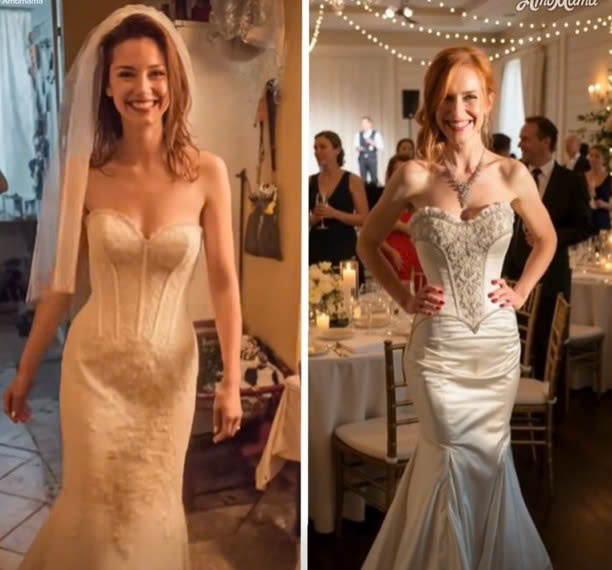
The real issue began during a Sunday dinner at my dad’s house. Out of nowhere, Janine announced—dramatically—that she had already picked out her outfit for the wedding. Then she showed me her phone, revealing a full-length ivory gown with lace and a mermaid silhouette. It wasn’t just white—it was unmistakably bridal. My sister Chloe almost choked on her water, and even Evan looked stunned. Dad stayed quiet, which somehow made the moment worse.
I calmly asked Janine not to wear something that resembled a wedding dress. She waved her hand dismissively, insisting no one would confuse her with me. But the part that shocked me most was her next confession: she knew exactly what my wedding dress looked like because my dad had shown her the photo I’d shared with him privately. I felt disappointed and betrayed, though Dad insisted he didn’t realize it would matter.
The following morning, everything escalated when my seamstress called. Janine had reached out asking for a dress made with the same pattern as mine—only “more glamorous.” That was the moment I realized she wasn’t just trying to shine. She wanted to overshadow me completely.
I talked with Chloe, who immediately agreed that confronting Janine directly would only create more chaos. Instead, I came up with a plan—one that required patience, subtlety, and a quiet confidence I didn’t realize I had.
First, I emailed every woman attending the wedding and asked them, politely and excitedly, to wear soft rustic shades: ivory, cream, or off-white. I framed it as a fun aesthetic choice to match the fall theme. Nearly everyone agreed. I intentionally left Janine off the list.
Next, I visited my seamstress again and commissioned a brand-new wedding dress—something vibrant and completely different from the original. We designed a flowing sunflower-yellow gown with lace accents and a golden sash. It was bold, whimsical, and impossible to miss.
When the wedding day arrived, the farmhouse backyard looked like a dreamy autumn painting. String lights glowed against the warm leaves, the air smelled like smoked brisket, and every woman in sight was dressed in ivory or cream—just as planned.
Janine arrived proudly in her dramatic ivory gown, fully expecting to be the visual centerpiece of the day. Her expression shifted the moment she saw the crowd. Dozens of women matched her outfit. Her attempt to stand out had instantly backfired.
And then she saw me.
My yellow dress caught the sunlight, making me look like a living burst of warmth against the backdrop of fall colors. Janine blinked, realizing that her strategy had been undone in the most elegant way possible. She wasn’t angry yet—just confused—but the murmurs among guests didn’t help.
During the reception, Janine tried several times to pull attention toward herself. She laughed loudly during speeches, made exaggerated comments, and even tried to insert herself into conversations about the décor. But no one was paying extra attention to her anymore. Her moment had quietly dissolved.
The real turning point came when my dad gave a heartfelt speech about watching me grow into a strong and compassionate woman. Janine tried to stand with him as if she were part of the tribute, but before she could speak, my mom’s best friend stepped forward and delivered a beautiful message about grace—specifically mine. She subtly acknowledged my ability to rise above pettiness without ever naming Janine directly. The room erupted in applause.
After the wedding, Dad called to apologize. He admitted he should have noticed the red flags earlier and that Janine had been manipulating more than just conversations—she’d been using his credit card without his knowledge. Their relationship ended shortly after. It hurt him, but ultimately he was relieved.
Looking back, I’m proud I didn’t let anger take over. I didn’t yell or argue. Instead, I chose creativity and quiet strength. And in the end, I celebrated my wedding day on my own terms—full of love, joy, and a small victory that made everyone smile.